Maritime Pine Bark: Antioxidant Support for the Brain
Quick Answer: Does Maritime Pine Bark Help the Brain?
Maritime pine bark is a concentrated source of proanthocyanidin antioxidants studied for supporting healthy circulation and easing oxidative stress. Early human trials link it to better attention and blood-vessel function, but the effect is modest and the strongest data come from one branded, standardised extract. Treat it as antioxidant and circulatory support, not a memory cure.
- Main appeal: proanthocyanidins for antioxidant and blood-flow support.
- Typical dose: 50–150 mg/day of a standardised extract, taken with food.
- Key caveat: generic powders are not the same as the studied branded extract.
What maritime pine bark actually is
Maritime pine bark extract comes from the bark of Pinus pinaster, a pine that grows along the coast of south-west France and parts of the Mediterranean. The bark is milled and extracted to concentrate a family of water-soluble plant compounds called proanthocyanidins, along with related phenolic acids and bioflavonoids. These are the same broad class of antioxidants found in grape seed, cocoa and green tea, which is why you will often see pine bark grouped with those ingredients on a nootropic label.
The reason pine bark has drifted into the cognitive-support conversation is not that it acts like a stimulant or a classic memory drug. It does not sharply raise acetylcholine the way Huperzine A does, and it does not act on dopamine the way an amino acid such as L-tyrosine can. Instead, its case rests on two quieter mechanisms that matter to a demanding brain: mopping up oxidative stress, and supporting the lining of blood vessels so circulation stays healthy. Those are supporting-cast roles, and honest coverage keeps them there.
The antioxidant angle: proanthocyanidins
Brain tissue is metabolically expensive. It burns a large share of the body's oxygen and glucose, and that high turnover generates reactive oxygen species as a by-product. In moderation the body neutralises them; under chronic stress, poor sleep or ageing, the balance can tip toward oxidative stress. Proanthocyanidins are studied precisely because they can donate electrons to stabilise those reactive molecules and, in lab settings, help recycle other antioxidants such as vitamins C and E.
It is worth being precise about what this does and does not prove. Demonstrating antioxidant activity in a test tube, or even measuring a rise in a person's blood antioxidant capacity, is a long way from showing a real-world change in memory or focus. Antioxidant capacity is a plausibility argument, not an outcome. The useful question is always whether trials measured something people care about, such as attention on a task, and the answer for pine bark is a cautious, early yes in a handful of small studies.
Blood flow, nitric oxide and the vascular case
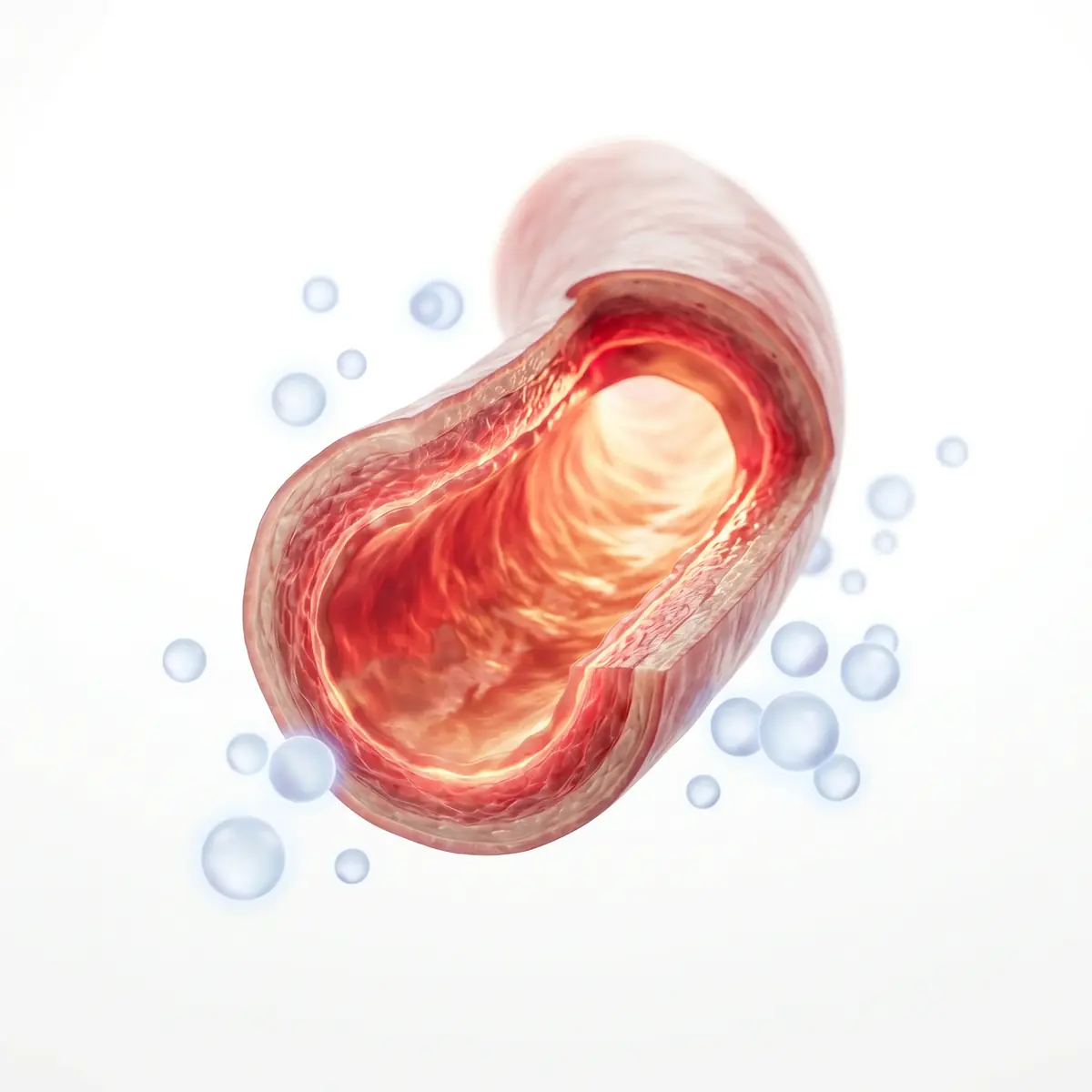
The second mechanism is where pine bark gets more interesting. Several studies suggest its compounds can support the body's production of nitric oxide, a signalling molecule that relaxes the smooth muscle in blood-vessel walls and lets vessels widen. Better endothelial function means blood, oxygen and nutrients move more freely. Since the brain depends utterly on a steady blood supply, anything that supports healthy circulation is at least mechanistically relevant to mental stamina and clarity.
This is also why pine bark is sometimes compared to Ginkgo biloba, another botanical whose reputation rests on circulation. The comparison is fair up to a point: both are studied for vascular support rather than for directly rewiring memory. Where you have to stay careful is the leap from "improves a marker of circulation" to "increases blood flow to your brain and makes you think faster." Small trials have measured circulation improvements, but robust, brain-specific blood-flow data in healthy adults is still thin.
What the attention research shows
The most relevant human work has looked at attention, mental fatigue and sustained concentration rather than raw memory. In these trials, participants taking a standardised extract over several weeks reported or showed modest gains in staying on task, with a favourable safety profile. The studies are small, some are open-label rather than fully blinded, and several were conducted with the branded material by researchers connected to it. None of that makes the findings worthless; it makes them preliminary. A sensible reader files pine bark under "promising, under-powered" rather than "established."
Pycnogenol versus generic pine bark extract
This is the single most important practical point, and it trips up a lot of shoppers. Most of the quality human research on maritime pine bark was done on Pycnogenol, a specific patented extract standardised to a defined proanthocyanidin content. When a study reports a benefit, it is really reporting a benefit for that standardised material at a known dose.
A generic "pine bark extract" powder contains the same family of compounds, but the concentration of active proanthocyanidins can vary enormously between suppliers, and cheaper material may be under-extracted or poorly characterised. So a marketing line that borrows Pycnogenol's study results to sell an unbranded, unstandardised powder is quietly overreaching. If the vascular and attention data matter to you, the standardisation on the label matters just as much as the milligram number.
Dosage: what the studies used
Across the published human literature, the working range for a standardised maritime pine bark extract is roughly 50 to 150 mg per day. Lower doses around 50 mg show up in general antioxidant and vascular studies; attention and cognition work has tended to sit in the middle of the range, often split into one or two daily doses taken with food to aid absorption. More is not automatically better, and there is no good evidence that megadosing adds benefit.
| Use context | Typical studied range |
|---|---|
| General antioxidant / vascular support | 50–100 mg/day |
| Attention and mental stamina studies | ~100–150 mg/day, over several weeks |
| Timing | With food; can be split into one or two doses |
| What to check on a label | Standardised proanthocyanidin content, not just total mg |
Why it is often paired with choline sources
On many nootropic labels you will find pine bark alongside a choline source such as citicoline or alpha-GPC. The logic is that the two ingredients play different positions. Choline feeds the raw material for acetylcholine, the neurotransmitter tied to learning and attention, while pine bark works on the plumbing and the antioxidant environment those neurons operate in. It is a reasonable complementary pairing rather than a proven synergy, and it is fine to describe it that way: they address different parts of the same system, and no single trial has shown the combination beats its parts.
The same logic explains why pine bark rarely appears as a solo hero ingredient. Its effects are supportive and cumulative rather than fast and obvious. If you take one capsule and expect the jolt of a coffee, you will be disappointed, because that is simply not how an antioxidant and circulatory ingredient behaves.
Who might consider it, and who should be careful
For a generally healthy adult curious about antioxidant and circulatory support, a standardised pine bark extract in the studied dose range has a reassuring safety record in short-to-medium-term trials, with mild digestive upset the most common complaint. That said, because the ingredient can influence blood vessels and, in theory, blood pressure or clotting-related pathways, it deserves a real conversation with a clinician if you take blood-pressure or blood-thinning medication, are pregnant or nursing, or are heading into surgery.
Medical note: this article is general information, not medical advice. Speak to a healthcare professional before starting any supplement, especially if you are pregnant, nursing, managing blood pressure, or taking blood-thinning medication — ingredients that act on circulation can interact with those drugs.
Scientific references
Frequently asked questions
What does maritime pine bark do for the brain?
Maritime pine bark is a rich source of proanthocyanidins, plant antioxidants studied for supporting healthy blood flow and reducing oxidative stress. In the brain, researchers are interested in whether that combination supports attention and mental stamina. The human evidence is early and modest, so it is best seen as antioxidant and circulatory support rather than a memory cure.
Is Pycnogenol the same as pine bark extract?
Not exactly. Pycnogenol is a specific, patented, standardised extract of French maritime pine bark, and most of the published human trials used that branded material. Generic pine bark extracts contain the same family of compounds but can vary widely in concentration and quality, so a study on Pycnogenol does not automatically apply to an unbranded powder.
What is the pine bark dosage for focus?
Human studies have typically used around 50 to 150 mg of standardised maritime pine bark extract per day, often split into one or two doses with food. Attention-related trials tended to sit in the middle of that range over several weeks. Always match a product label to the doses used in research rather than assuming more is better.
Does pine bark improve blood flow to the brain?
There is a plausible mechanism and some supportive data. Maritime pine bark compounds are studied for helping the body produce nitric oxide, which relaxes blood vessels, and small trials have measured improvements in circulation markers. Whether that reliably increases blood flow to the brain in healthy people is still an open question rather than a settled fact.
Related reading
Same blood-flow goal, a different ingredient route
HoneyPezil skips the antioxidant botanicals and goes straight at nitric oxide with 400 mg of arginine and 200 mg of citrulline per daily capsule.