L-Citrulline and L-Arginine for Brain Blood Flow
Quick Answer: Do Arginine and Citrulline Improve Brain Blood Flow?
Partly. L-arginine is the direct precursor of nitric oxide, the molecule that relaxes blood-vessel walls, and L-citrulline raises plasma arginine more reliably than oral arginine does because it escapes first-pass breakdown in the gut and liver. That biochemistry is solid. What is not established is that raising nitric oxide availability produces a measurable memory or focus benefit in healthy adults — the cognitive trials are few, small and mixed.
- Best-evidenced effect: raising plasma arginine and nitric oxide markers, and improving vascular function in people who start out impaired.
- Typical research doses: roughly 3–9 g a day of arginine, or 3–6 g a day of citrulline.
- Honest limit: better blood flow on a machine is not the same thing as better thinking on a test.
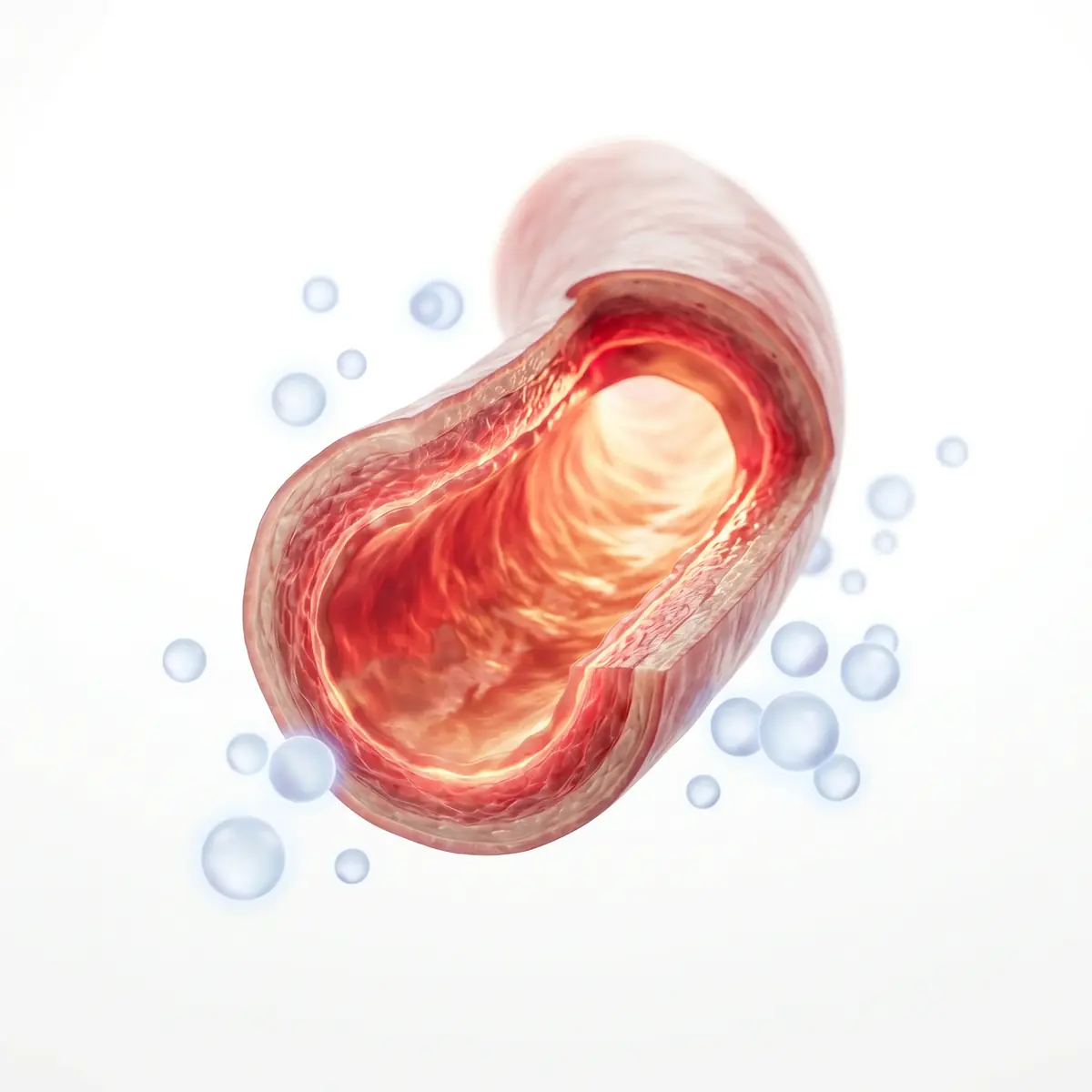
What nitric oxide actually does in the brain
Nitric oxide is a short-lived gas your blood-vessel lining makes on demand. When the endothelium — the single-cell layer lining every artery — releases nitric oxide, the smooth muscle underneath relaxes and the vessel widens. That is the mechanism behind flow-mediated dilation, the standard clinical measure of vascular health, and it is the same mechanism that lets brain regions pull more blood when they start working harder.
The brain is unusually dependent on this. It is about 2% of body weight but takes roughly a fifth of resting cardiac output, and it stores almost no fuel, so it has to match delivery to demand minute by minute. That is why any ingredient which plausibly supports the endothelium gets looked at for brain benefits.
Nitric oxide is made from the amino acid L-arginine by an enzyme family called nitric oxide synthase. That single fact is the entire rationale for arginine-based formulas: supply more of the substrate, and in theory you support more of the product. Reality is less tidy, because how much arginine actually reaches your bloodstream turns out to be the hard part.
Why citrulline raises arginine better than arginine does
Swallowed L-arginine faces two obstacles before it can do anything useful. Gut bacteria and the intestinal wall metabolise a large share of it, and the liver removes much of what survives. The result is that a lot of oral arginine never reaches systemic circulation at all — a first-pass problem that has frustrated arginine research for decades.
L-citrulline takes a detour around the whole obstacle course. It is absorbed largely intact, is not a substrate for the same degrading enzymes, and is converted into arginine in the kidneys. A controlled pharmacokinetic study by Schwedhelm and colleagues in the British Journal of Clinical Pharmacology (2008) compared the two head to head and found that oral citrulline raised plasma arginine more effectively than an equivalent dose of arginine itself, and shifted markers of nitric oxide metabolism with it. That paper is the reason well-built formulas list both amino acids instead of loading up on arginine alone.
Arginine, arginine AKG and citrulline compared
| Form | What it is | What to expect |
|---|---|---|
| L-arginine (base) | The direct nitric oxide precursor | Works, but a large share is destroyed before it reaches the blood |
| L-arginine AKG | Arginine bound to alpha-ketoglutarate | A delivery strategy; the human evidence that it beats plain arginine is thin |
| L-citrulline (HCl or base) | Converted to arginine in the kidneys | Raises plasma arginine more reliably, gram for gram, than arginine |
| L-citrulline malate | Citrulline bound to malic acid | The form used in most exercise research; malate adds nothing proven for cognition |
What the evidence shows — and what it does not
What it shows. Oral L-arginine does move vascular endpoints in people whose vessels are already impaired. A systematic review and meta-analysis by Rodrigues-Krause and colleagues in Nutrients (2018) found associations between L-arginine supplementation and improved markers of endothelial function in patients with cardiovascular or metabolic disorders. The pharmacology from the citrulline work holds up too: the substrate story is real, and the amounts needed to move it are known.
What it does not show. There is no good body of evidence that arginine or citrulline improves memory, attention or processing speed in healthy adults. A small acute trial of a specific patented arginine form, inositol-stabilised arginine silicate, reported cognitive improvements in healthy adults in Nutrients (2021), but that is one short study of one proprietary compound, not a general finding about arginine, and it should not be read as evidence for a different form at a different dose.
The most useful corrective comes from the wider nitric oxide field. If simply raising nitric oxide availability improved cognition, dietary nitrate should do it, because nitrate is the most efficient way we know to raise nitric oxide. Yet a 13-week randomised trial by Babateen and colleagues in Nutrients (2022) gave incremental doses of nitrate-rich beetroot juice to overweight and obese older adults and found no modification of cognitive function or cerebral blood flow. That is a genuinely informative negative result, and anyone selling you the blood-flow story owes you an honest account of it.
The fair summary: the mechanism is real, the vascular effects are real in the right populations at the right doses, and the leap from there to sharper thinking is currently unsupported. The same gap shows up across this shelf — it is what the cocoa flavanol blood-flow trials ran into as well.

How much arginine and citrulline do the trials actually use?
This is the number that decides whether a product is worth your money, and it is the one most labels would rather you skipped. Oral L-arginine trials for vascular endpoints generally sit in the range of about 3 to 9 grams a day, usually split across doses. Citrulline studies commonly use 3 to 6 grams a day, with the pharmacokinetic work showing clear plasma arginine responses in that territory.
Now hold that against a typical Supplement Facts panel. Amounts in the hundreds of milligrams are an order of magnitude below the research range. That does not make a product fraudulent — a label that prints its amounts openly is doing the honest thing — but it does mean you should not expect the effects described in the trials. The practical skill here is arithmetic, not chemistry, and it is the core habit in our guide to reading a supplement label: find the studied dose first, then check whether the panel is anywhere near it.
One wrinkle worth knowing: when a panel lists both L-arginine and L-arginine AKG, or both citrulline HCl and citrulline malate, adding the two entries together is reasonable shorthand for total amino acid, but the bound forms mean you are not receiving that full weight as delivered, bioavailable amino acid.
Where beta-alanine fits, and why small amounts are not a dose
Beta-alanine is a common companion ingredient in this category, and it is one of the clearest examples of a dose that has been quietly amputated. Beta-alanine works by combining with histidine to build muscle carnosine, a buffer against the acidity that accumulates during hard, short efforts. That is an exercise mechanism, not a cognitive one, and the amounts required are substantial: the International Society of Sports Nutrition position stand on beta-alanine (J Int Soc Sports Nutr, 2015) describes roughly 4 to 6 grams a day sustained over weeks to raise carnosine meaningfully.
Against that benchmark, a panel listing a few dozen milligrams provides on the order of one percent of a studied dose. Read it as a formulation inclusion, not an active dose. It also will not cause the harmless tingling that larger beta-alanine doses famously produce, which is a useful tell.
Why niacin turns up in blood-flow formulas
Niacin is vitamin B3, an essential nutrient with recognised roles in normal energy-yielding metabolism and normal nervous-system function. It also has a second, quite different reputation: at high pharmacological doses, niacin is a potent vasodilator, which is what produces the well-known flushing sensation. That association is presumably why it appears in formulas built around blood flow.
The distinction matters. A nutritional amount — single-digit milligrams NE, a fraction of the Daily Value — is a vitamin inclusion, not a vasodilating dose. There is nothing wrong with including it; there would be something wrong with treating it as the engine of the formula.
Amino acids or botanicals: why some memory formulas skip the herbs
Most of the memory shelf is botanical: bacopa, ginkgo, lion’s mane, rhodiola. A minority takes the amino-acid route instead, betting on circulation rather than neurotransmission. It has one practical advantage — amino acids are chemically defined, so there is no standardisation puzzle of the kind that makes botanical extracts hard to compare.
The trade-off is evidential. Botanicals such as bacopa have randomised trials measuring memory outcomes directly; the strongest arginine and citrulline evidence measures vascular markers instead, largely in clinical populations. Neither route has produced large, reliable cognitive gains in healthy adults. Our piece on common myths about brain supplements covers why "supports blood flow" and "improves memory" are not interchangeable claims, and the nootropic side effects and safety guide covers what to watch for either way.
Common mistakes with arginine and citrulline
- Reading a mechanism as a result. "Precursor of nitric oxide" is a chemical relationship, not a proven outcome.
- Ignoring the dose gap. A few hundred milligrams against a multi-gram research range is the most important number on the panel.
- Assuming exercise findings transfer. Most citrulline malate research concerns muscular performance, not memory.
- Expecting a same-day effect. Vascular changes in trials are measured over weeks.
- Stacking blindly with medication. Anything acting on vessel dilation deserves a clinician conversation if you take nitrate or blood-pressure drugs.
Who should be careful
Arginine and citrulline are generally well tolerated at supplement amounts, with digestive upset the most common complaint at larger doses. The caution that matters is pharmacological. Because these amino acids act on the nitric oxide pathway, anyone taking nitrate medication for angina, PDE5 inhibitors or blood-pressure drugs should clear them with a prescriber. The same applies after a recent heart attack, in pregnancy or nursing, or with kidney disease, since the kidneys perform the citrulline-to-arginine conversion.
None of this is cause for alarm at the amounts found on ordinary panels. It is a reason to bring the actual label to the actual appointment.
Medical note: this article is general information, not medical advice. Supplements that act on blood-vessel dilation can interact with prescription medication, particularly nitrates, PDE5 inhibitors and blood-pressure drugs. Speak to a healthcare professional before starting, especially if you are pregnant, nursing, managing cardiovascular or kidney conditions, or taking medication.
Frequently asked questions
Does L-citrulline increase blood flow to the brain?
Citrulline reliably raises plasma arginine and nitric oxide markers, and nitric oxide is the signalling molecule that relaxes blood-vessel walls throughout the body, including the cerebral circulation. What has not been shown is that this translates into a measurable cognitive benefit in healthy adults. The plumbing step is well evidenced; the thinking step is not.
Is L-citrulline better than L-arginine?
For raising plasma arginine, yes. Oral arginine is heavily broken down in the gut and liver before it reaches the bloodstream, while citrulline bypasses that first-pass metabolism and is converted to arginine in the kidneys. Gram-for-gram, citrulline lifts plasma arginine more effectively than arginine itself, which is why serious formulas pair the two rather than relying on arginine alone.
How much arginine or citrulline do studies use?
Human trials of oral L-arginine for vascular endpoints typically use several grams a day, often 3 to 9 g, and citrulline studies commonly use 3 to 6 g. Supplement panels frequently list far smaller amounts. If a label shows a few hundred milligrams, that is well below the amounts used in the research, and you should judge it accordingly.
Is 40 mg of beta-alanine a useful dose?
No, not by the standard of the published research. The International Society of Sports Nutrition position stand on beta-alanine describes roughly 4 to 6 g a day for several weeks to raise muscle carnosine. Forty milligrams is a small fraction of that, so it should be read as a formulation inclusion rather than a dose expected to do what the beta-alanine literature describes.
Why is niacin in a nitric oxide formula?
Niacin (vitamin B3) is an essential nutrient involved in normal energy-yielding metabolism and normal nervous-system function, and at high pharmacological doses it is also a vasodilator, which is where the flushing sensation comes from. A nutritional amount of a few milligrams NE is not a flushing dose and should be read as a vitamin inclusion, not as the active driver of any blood-flow effect.
Scientific references
- Schwedhelm E. et al. — Pharmacokinetic and pharmacodynamic properties of oral L-citrulline and L-arginine: impact on nitric oxide metabolism, Br J Clin Pharmacol (2008)
- Rodrigues-Krause J. et al. — Association of L-arginine supplementation with markers of endothelial function in patients with cardiovascular or metabolic disorders: a systematic review and meta-analysis, Nutrients (2018)
- Babateen A.M. et al. — Incremental doses of nitrate-rich beetroot juice do not modify cognitive function and cerebral blood flow in overweight and obese older adults, Nutrients (2022)
- Trexler E.T. et al. — International Society of Sports Nutrition position stand: Beta-Alanine, J Int Soc Sports Nutr (2015)
- Gills J.L. et al. — Acute inositol-stabilized arginine silicate improves cognitive outcomes in healthy adults, Nutrients (2021)
- NIH Office of Dietary Supplements — Niacin fact sheet for health professionals
Related reading
Looking for a stimulant-free daily capsule?
HoneyPezil contains no rhodiola and no caffeine — its panel lists arginine, citrulline, beta-alanine, niacin and calcium, each at a printed amount.