Cocoa Flavanols for Brain Function: What Trials Show
Do cocoa flavanols improve brain function?
Cocoa flavanols are plant compounds in the cocoa bean that support the lining of your blood vessels, and short studies have measured increased blood flow to parts of the brain after a flavanol-rich drink. Effects on actual memory and attention scores are inconsistent, and the largest long-term trial of a daily cocoa extract did not deliver the broad cognitive benefit researchers expected. The fair summary is circulation support with modest and uneven cognitive read-through.
- Study dose: commonly around 500 to 1,000 mg of cocoa flavanols per day.
- Mechanism: supports nitric oxide signalling and blood vessel dilation.
- Evidence strength: reasonable for blood flow, weak and mixed for cognition.
Cocoa is one of the few supplement stories that begins in a food most people already enjoy, which makes it unusually prone to wishful thinking. Headlines routinely promise that chocolate is good for your brain. The underlying science is more interesting and considerably narrower than that, and it hinges on a family of compounds most chocolate manufacturing actively removes. This is what the research supports, what it does not, and how to judge a product that claims a flavanol dose.
What cocoa flavanols actually are
Flavanols are a subgroup of polyphenols, the large family of plant compounds that also includes the pigments in berries and the tannins in tea. In cocoa the main players are epicatechin, catechin, and procyanidins, which are chains of those smaller units linked together. Epicatechin is the one most often measured in trials because it is the best absorbed and the easiest to track in blood, and much of the vascular research effectively treats it as the active fraction.
These compounds are not nutrients in the vitamin sense. You have no dietary requirement for them and there is no deficiency state. They are better understood as bioactive plant chemicals that interact with specific signalling systems in the body, which is exactly why the research question is narrow: not "is cocoa healthy" but "does this particular set of molecules do this particular measurable thing".
One more detail matters before anything else: flavanols taste bitter and astringent. Every step that makes cocoa palatable, from fermentation and roasting to alkalising, tends to reduce them. That single fact explains most of the gap between what the trials use and what is sitting in a supermarket aisle.
How cocoa flavanols reach the brain
Absorption is the first hurdle and it is a real one. The larger procyanidin chains are poorly absorbed intact; much of what you swallow passes to the colon, where gut bacteria break it into smaller phenolic metabolites. The smaller monomers such as epicatechin do cross the gut wall, then get heavily modified by the liver into sulfate, glucuronide and methylated forms. What circulates in your blood after a cup of flavanol-rich cocoa is therefore not the molecule that was in the bean, and plasma levels of these metabolites peak within a couple of hours and clear within a day.
This has two consequences worth holding on to. First, whether meaningful amounts of any flavanol metabolite cross the blood-brain barrier in humans is still an open question, and a lot of the enthusiasm in this field rests on cell and animal work rather than settled human data. Second, and more importantly, the effect that is well demonstrated in humans does not require the brain to absorb anything at all. It happens in the blood vessels themselves.
What cocoa flavanols for brain function do to blood flow
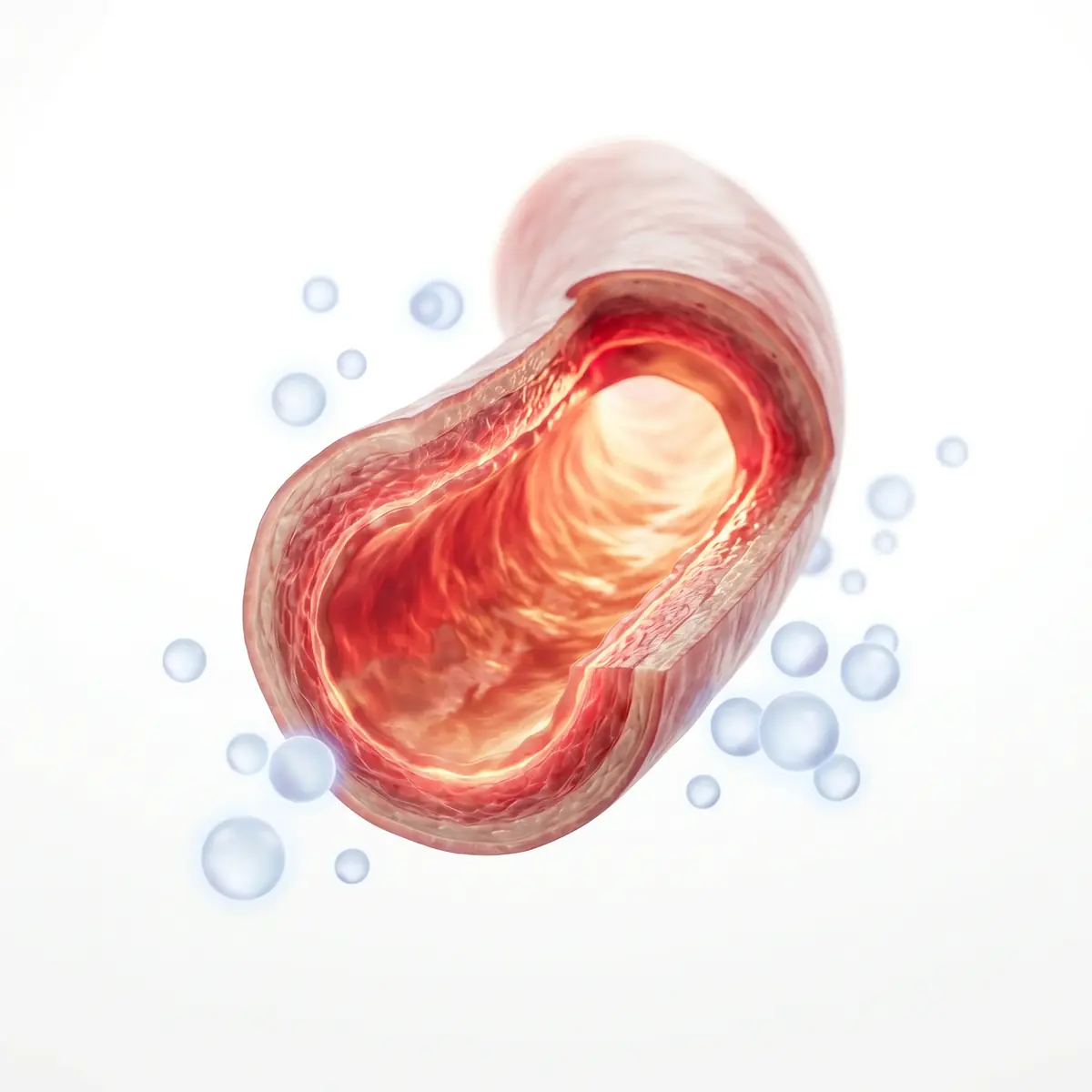
The strongest human finding for cocoa flavanols for brain function is vascular. Flavanol metabolites appear to support the availability of nitric oxide, the signalling molecule the endothelium uses to tell the surrounding smooth muscle to relax. When that signalling works well, vessels dilate more readily in response to demand. Researchers measure this with flow-mediated dilation, a straightforward ultrasound test of how much an artery widens after blood flow is briefly restricted and released.
This effect is consistent enough that European food regulators accepted a claim linking a modest daily amount of cocoa flavanols, roughly 200 mg, to normal endothelium-dependent vasodilation. That is a claim about blood vessel behaviour, not about thinking, and the distinction is the whole ballgame. Separately, small imaging studies using MRI have reported increased blood flow in specific brain regions in the hours after a high-flavanol drink, and some work has looked at oxygenation in the frontal cortex during demanding tasks.
So the mechanistic chain is plausible: better endothelial function, more responsive small vessels, more blood delivered where the brain is working hardest. Where it gets shaky is the final link, from measured perfusion to measured performance.
Looking for a memory formula with named doses?
If you are shopping for the best brain supplement for memory and focus, the first thing to check is whether every active is printed with its amount. HoneyPezil is a honey-based daily capsule built around six named actives, including ginkgo biloba for the same circulation question cocoa raises.
See the HoneyPezil labelWhat the cognition trials actually found
Here is where an honest article has to slow down. A number of small, short studies have tested cocoa flavanols against cognitive tasks, and the results are genuinely mixed. Some reported modest improvements on specific measures, often in older adults, often on tasks with a heavy attention or processing-speed component, and often only when the task was hard enough to stress the system. Others found nothing. Effects, where present, have generally been small.
The most informative data point is also the least flattering. A large, long-running trial programme tested a daily cocoa extract in older adults over years, alongside a separate multivitamin arm, and the cocoa extract did not produce the broad cognitive benefit the field had been anticipating. Interestingly, the multivitamin arm looked more promising in some analyses. When a well-powered, multi-year trial fails to confirm what a stack of small short-term studies suggested, the sensible response is to downgrade confidence, not to explain the result away.
A short study showing more blood flowing through a brain region is not the same as a person thinking better, and the gap between those two things is where most supplement marketing lives.
There is also a persistent design problem. Cocoa naturally contains caffeine and theobromine, both mild stimulants. Unless a trial matches those between the flavanol drink and the control drink, any short-term sharpening could simply be a small caffeine effect wearing the costume of a flavanol effect. The better studies control for this; not all do, and this alone accounts for some of the inconsistency in the literature.
Why chocolate is a poor delivery system
People reasonably ask whether they can skip supplements and eat chocolate instead. The problem is that flavanol content in finished chocolate is both low and wildly variable, and nothing on the wrapper tells you which you have bought. Cocoa percentage is a measure of total cocoa solids plus cocoa butter, not of flavanols, so a very dark bar made from heavily alkalised cocoa can carry less than a lighter bar made from minimally processed beans.
Cocoa sources compared
| Form | Typical flavanol level | Reliability of the dose | Other considerations |
|---|---|---|---|
| Standardised cocoa flavanol extract | High, and stated on the label | Good — the amount is printed | The only form used in most trials |
| Natural (non-alkalised) cocoa powder | Moderate to high | Poor — varies by bean and batch | Bitter; usually needs sweetening |
| Dutch-processed (alkalised) cocoa | Low | Poor | Alkalising removes much of the flavanol content |
| Dark chocolate bar | Low to moderate | Poor — never stated | Carries sugar, fat and calories |
| Milk chocolate | Very low | Not a practical source | Mostly sugar, milk solids and cocoa butter |
The practical rule follows directly. If you actually want the amount used in research, you need a product that declares milligrams of cocoa flavanols, ideally with the epicatechin content named. If a label says only "cocoa extract" with no flavanol figure, you are buying an unknown quantity. This is the same label discipline that separates a serious formula from a decorative one across the whole category, and it is worth applying before you compare where to buy brain supplements at all.

Dose, timing and a fair personal trial
Trials have clustered around roughly 500 to 1,000 mg of cocoa flavanols per day, usually as a single daily drink or capsule dose, while the regulatory claim about vessel dilation sits far lower at about 200 mg. That is a wide spread, and it reflects genuine uncertainty about what a useful amount looks like rather than a settled consensus.
Timing is simpler than for most nootropic ingredients because the vascular effect is acute. Metabolites peak within a couple of hours and are gone within a day, so there is nothing to accumulate and no loading period to observe. If you want to test whether a flavanol dose does anything noticeable for you, take it in the morning on a work day and pay attention to the afternoon rather than the first hour. Because cocoa carries caffeine and theobromine, late dosing is the main way people accidentally disrupt their own sleep and then blame the ingredient for a foggy next day.
One caution on self-assessment: attention feels different on different days for reasons that have nothing to do with what you swallowed. Sleep debt, hydration, stress and how interesting your work is that morning all swamp a small pharmacological effect. If you are going to trial anything, keep the rest of your week as boring and consistent as you can, and do not draw conclusions from a single good afternoon.
Safety and who should be careful
Cocoa flavanol extracts have a good tolerability record in healthy adults at the amounts used in studies. The realistic issues are mundane. Cocoa contains caffeine and theobromine, and some extracts add more caffeine deliberately, so a large evening dose can cost you sleep. High-cocoa foods also carry oxalates, which is worth knowing if you have a history of kidney stones. Cocoa products can concentrate trace heavy metals such as cadmium from the soil the trees grew in, which is a reason to prefer manufacturers who publish contaminant testing.
The genuine conversations to have with a clinician are these: if you take blood pressure medication, because a vasodilatory ingredient stacked on a vasodilatory drug is worth flagging; if you take blood-thinning medication; and if you are pregnant, nursing or managing any health condition. None of that makes cocoa dangerous. It makes it a substance with real effects, which is precisely why it deserves the same care as anything else with real effects.
What cocoa flavanols cannot do
Three limits deserve stating plainly. First, cocoa flavanols do not treat, prevent or reverse any disease, and nothing here should be read as being about dementia or any diagnosed condition; progressive memory change needs a clinician, not a supplement aisle. Second, the cognitive evidence is weaker than the vascular evidence, and the largest long-term trial did not support the broad benefit that smaller studies had hinted at. That is a meaningful negative result and it should temper expectations rather than be quietly omitted.
Third, flavanols are an acute vascular ingredient, not a memory-building one. They work on a different layer of the problem than the slow, cumulative ingredients such as bacopa monnieri, which need eight to twelve weeks of daily use before a fair judgement can be made. If your goal is recall rather than circulation, cocoa is not the lever to pull, and a formula that leans on it as its memory story is telling you more about its marketing than its pharmacology. For the circulation angle specifically, our piece on ginkgo biloba, memory and blood flow covers the better-studied botanical route to the same question.
Medical note: this article is general information, not medical advice. Speak to a healthcare professional before starting any supplement, especially if you are pregnant, nursing, taking blood pressure or blood-thinning medication, or managing a health condition.
Scientific references
- Mastroiacovo D. et al. — Cocoa flavanol consumption improves cognitive function, blood pressure control, and metabolic profile in elderly subjects: the CoCoA randomized controlled trial, Am J Clin Nutr (2015)
- Brickman A.M. et al. — Enhancing dentate gyrus function with dietary flavanols improves cognition in older adults, Nat Neurosci (2014)
- Harvard T.H. Chan School of Public Health — The Nutrition Source: Dark Chocolate
- NIH NCCIH — Dietary and Herbal Supplements
- NIH Office of Dietary Supplements — ingredient fact sheets
Frequently asked questions
Do cocoa flavanols improve memory?
The honest answer is that the evidence is mixed. Short studies have measured better blood flow in parts of the brain after a flavanol-rich cocoa drink, and a few small trials reported modest gains on specific attention or recall tasks. But the largest long-term trial of a daily cocoa extract did not produce the broad cognitive benefit researchers had hoped for. Cocoa flavanols look like circulation support rather than a memory ingredient.
How many cocoa flavanols do you need per day?
Most human trials have used roughly 500 to 1,000 mg of cocoa flavanols per day, usually as a standardised drink or extract taken once daily. European regulators have accepted a much lower figure, around 200 mg per day, in relation to normal blood vessel dilation. Because cocoa products rarely state a flavanol amount, a standardised extract is the only reliable way to know what you are getting.
Is dark chocolate a good source of cocoa flavanols?
It is a better source than milk chocolate, but it is still unreliable. Flavanols are bitter, so most manufacturing steps, especially alkalising or Dutch processing, strip a large share of them out. Two bars with the same cocoa percentage can differ enormously in flavanol content, and neither one prints the number on the wrapper. Chocolate is a pleasure food that sometimes carries flavanols, not a dose you can count on.
Are cocoa flavanol supplements safe?
For most healthy adults, cocoa flavanol extracts are well tolerated at the amounts used in studies. Two practical points matter. Cocoa naturally contains caffeine and theobromine, so a large dose late in the day can disturb sleep for sensitive people, and some extracts add caffeine on purpose. If you take blood pressure or blood-thinning medication, or you are pregnant or nursing, check with your doctor first.
A blood-flow formula that names every amount
HoneyPezil works the same nitric-oxide pathway from the amino-acid side: L-arginine 200 mg, L-arginine AKG 200 mg and 200 mg of citrulline per daily capsule.